Charismatic Roots (all
based on experience as truth)
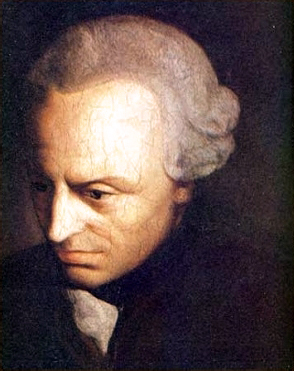 Immanuel
Kant: Immanuel
Kant:
Transcendental idealism: Perhaps the best way to
approach transcendental idealism is by looking at how in Kant's view we
acquire intuitions. What's relevant here is that space and time, rather
than being real things-in-themsleves, are properties we attribute to
objects in perceiving them. Humans perceive objects spatially and
temporally. This is part of what it means for a human to cognitize an
object, to perceive it as something both spatial and temporal. These are
all claims Kant argues for in the Transcendental Aesthetic. This is not
to say that space is nothing more than an appearance. It is simply to
say that all it can possibly mean for something to be spatial is that it
is something experienced via human capacities for experiencing that
thing. Kantian Idealism held that there was a Moral Law within people
that shapes their impressions and that there was a set of innate
principles with reference to which the mind gives form to its
perceptions and interprets life experiences. Kant was sure that he had
effected a "Copernican Revolution," persuasively suggesting
that is the representation that makes the object possible rather than
the object that makes the representation possible. Kant said there were
experiences that could be acquired through "intuitions of the
mind;" he referred to the "native spontaneity of the human
mind." This introduced the human mind as an active originator of
experience rather than a passive recipient. It also leaves the way
dramatically open for the mind to be viewed as a creative, intuitive,
and interpreting organism rather that a reactive and logical machine.
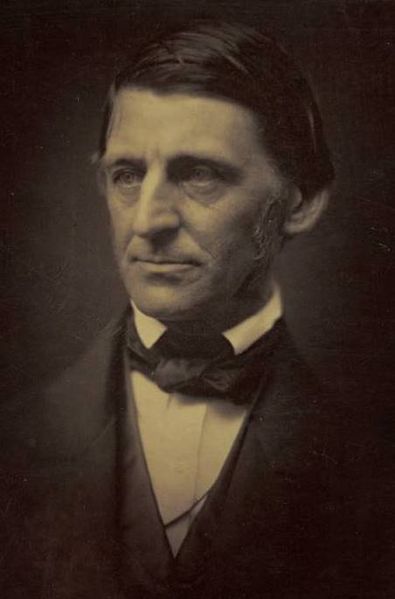 Ralph
Waldo Emerson: Ralph
Waldo Emerson:
American
style Transcendentalism had its birth in early 19th century
Boston. In 1832, Ralph Waldo Emerson, a brilliant man by all
historical accounts, resigned his position as Pastor of a Unitarian
Church and went on to spearhead the transcendental movement as a
reaction against the more orthodox idea that God was distinct from His
creation. He held the Gnostic position that everything was divine,
and that God could be found in everything, (metaphysical monism).
Emerson, whose thinking was reminiscent of the neo-platonic idea of
universal mind, believed that nature, man, and God were really part of
an unseen reality; a reality which couldn't be grasped by the senses, or
the intellect; but rather by intuition. Emerson, along with Henry David
Thoreau and Margaret Fuller, were probably the best known American
transcendentalists.1
"What is popularly called Transcendentalism
among us, is Idealism... "The Transcendentalist adopts the whole
connection of spiritual doctrine. He believes in miracle, in the
perpetual openness of the human mind to new influx of light and power;
he believes in inspiration, and in ecstasy. He wishes that the spiritual
principle should be suffered to demonstrate itself to the end, in all
possible applications to the state of man, without the admission of
anything unspiritual; that is, anything positive, dogmatic, personal.
Thus, the spiritual measure of inspiration is the depth of the thought,
and never, who said it? And so he resists all attempts to palm other
rules and measures on the spirit than its own.... It is well known
to most of my audience that the Idealism of the present day acquired the
name Transcendental from the use of that term by Immanuel Kant, of
Konigsberg, who replied to the skeptical philosophy of Locke, which
insisted that there was nothing in the intellect which was not
previously in the experience of the senses, by showing that there was a
very important class of ideas or imperative forms, which did not come by
experience, but through which experience was acquired; that these were
intuitions of the mind itself; and he denominated them Transcendental
forms. The extraordinary profoundness and precision of that man's
thinking have given vogue to his nomenclature, in Europe and America, to
that extent that whatever belongs to the class of intuitive thought is
popularly called at the present day Transcendental."
Emerson's essay "The Transcendentalist" (1842).
Students of Emerson were:
- Phineas
Quimby
- Essek
W. Kenyon
- F.F. Bosworth
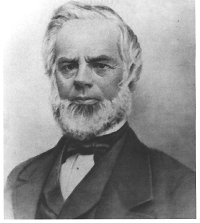 Phineas
Quimby: Healing Hypotheses Phineas
Quimby: Healing Hypotheses
From 1847 until his passing on January 16th, 1866,
Phineas Parkhurst Quimby devoted his life to healing the sick. In
the Fall of 1859 he opened an office at the International House Hotel in
the city of Portland, Maine. His youngest son George Albert Quimby
worked as his office clerk. Additional secretarial services were
supplied by two of his new patients, the sisters Emma and Sarah Ware.
Dr. Quimby, as he was now known, treated over 12,000 patients during
those years. Most notable were Warren Felt Evans, a practitioner
and author of mental healing; Julius and Annetta (Seabury) Dresser,
early organizers of New Thought; and Mary M. Patterson (Mary Baker
Eddy), of the Christian Science movement.
Horatio W. Dresser, son of Annetta Julius Dresser,
explained Quimby's ideas in a seven element list.
- 1. The omnipresent Wisdom, the warm,
loving Father of us all, Creator of all the universe, whose works
are good, whose substance is an invisible reality.
- 2. The real man, whose life is eternal
in the invisible kingdom of God, whose senses are spiritual and
function independently of matter.
- 3. The visible world, which Dr. Quimby
once characterized as "the shadow of Wisdom's amusements";
that is, nature is only the outward projection or manifestation of
an inward activity far more real and enduring.
- 4. Spiritual matter, or fine
interpenetrating substance, directly responsive to thought and
subconsciously embodying in the flesh the fears, beliefs, hopes,
errors, and joys of the mind.
- 5. Disease is due to false reasoning
in regard to sensations, which man unwittingly develops by
impressing wrong thoughts and mental pictures upon the subconscious
spiritual matter.
- 6. As disease is due to false
reasoning, so health is due to knowledge of the truth. To remove
disease permanently, it is necessary to know the cause, the error
which led to it. "The explanation is the cure."
- 7. To know the truth about life is
therefore the sovereign remedy for all ills. This truth Jesus came
to declare. Jesus knew how he cured and Dr. Quimby, without taking
any credit to himself as a discoverer, believed that he understood
and practiced the same great truth or science.
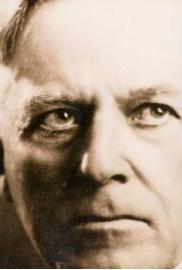 Essek
W. Kenyon: (born 1867) Essek
W. Kenyon: (born 1867)
E.W. Kenyon was the forth child born to a Logger
Father and a Mother that was a school teacher. Kenyon's was converted to
christianity in 1886 at the age of 19. Preaching his first sermon in a
Methodist church and later became a Baptist pastor who preached in many
Pentecostal circles. E.
W. Kenyon moved to Boston in 1892 an d attended Emerson College of
Oratory, a school that taught the religions and mind science ideas of
Phineas Quimby. E.W. Kenyon
was instrumental in teaching the "Word of Faith" to F.F.
Bosworth, John G. Lake, T.L. Osborn, and Kenneth Hagin, Sr.. Kenyon held
to the belief that truth is found in experience.
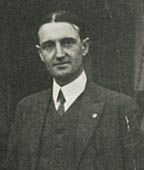 F.F.
Bosworth: F.F.
Bosworth:
He was an advisor to many of the early healing
revivalists such as William Branham, Oral Roberts, T.L. Osbourne, and
many others. Kenneth Hagin constantly refers to his teachings. F.F.
Bosworth worked with John Alexander Dowie for many years before entering
into his own successful healing ministry. Both F.F Bosworth, and John G.
Lake, from Zion knew Dowie well and learned about Divine Healing
initially from Dowie. 1907, Bosworth visited the Azusa Street Mission in
Los Angeles along with John G. Lake. Bosworth met and befriended the
great teacher and Healing Evangelist, Dr. E.W. Kenyon in Chicago.
Bosworth was a good friend of E.W. Kenyon, and was extremely like minded
with Kenyon in his teachings on the Bible and Divine Healing. Bosworth
was one of the founders, along with Lake, of the Assemblies of God in
1914. Truth based on experience.
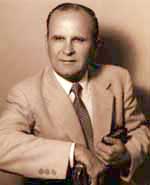 William
Branham: William
Branham:
The Voice accompanied Branham throughout his
lifetime, and eventually made itself known as an angel. This angel
directed him in every aspect of his personal life, and it was the angel
rather than the Holy Spirit to whom Branham gave credit for his power.
<Kurt Koch, Occult Bondage and Deliverance (Grand Rapids: Kregel,
1972), p. 50.>
Branham propagated what he called the
"Serpent’s Seed" teaching: the belief that Cain was produced
through a sexual union between Eve and the serpent in the garden. The
curse of the Serpent’s Seed, he believed, continues to plague mankind
through women, and is evidenced in their temptation of men. <William
M. Branham, My Life Story, p. 19.>
[Branham believed that some humans are
descended from the serpent’s seed and are destined for hell, which is
not eternal, however. The seed of God, i.e., those who receive Branham’s
teaching, are predestined to become the Bride of Christ. There are still
others who possess free will and who may be saved out of the
denominational churches, but they must suffer through the Great
Tribulation. He considered denominationalism a mark of the Beast (Rev.
13:17). <Dictionary of Pentecostal and Charismatic Movements,
pp. 95,96.>]
Another of Branham’s teachings was that the
Zodiac and the Egyptian pyramids were equal to the Scriptures in the
revelation of God’s Word. <William M. Branham, Adoption
(Jeffersonville, IN: Spoken Word Publications), pp. 31,104.>
[Branham proclaimed himself the angel of
Revelation 3:14 and 10:7 and prophesied that by 1977 all denominations
would be consumed by the World Council of Churches under the control of
the Roman Catholics, that the Rapture would take place, and that the
world would be destroyed. <Dictionary of Pentecostal and Charismatic
Movements, p. 96.>]
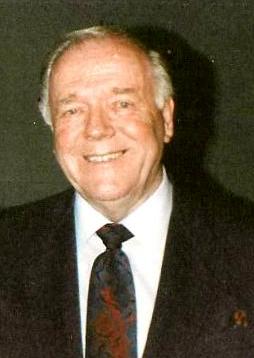 Kenneth
Hagin, Sr.: (a.k.a. "Dad" Hagin,
Father of the Word of Faith Movement, Prophet Hagin, Apostle Hagin.) Kenneth
Hagin, Sr.: (a.k.a. "Dad" Hagin,
Father of the Word of Faith Movement, Prophet Hagin, Apostle Hagin.)
Followed the teachings of Kenyon and based truth
on experience.
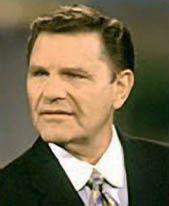 Kenneth
Copeland: Kenneth
Copeland:
Followed the teachings of Hagin and based truth on
experience.
Benny Hinn: etc., etc., etc.
- Avanzini,
John
John Avanzini Ministries
- Basansky,
Dr Bill
The Word Works
- Bell,
Buddy
Ministry of Helps Int'l
- Bonnke,
Reinhard
Christ For All Nations
- Brazee,
Mark & Janet
Mark Brazee Ministries
- Brown,
Tom
Tom Brown Ministries
- Browne,
Rodney Howard
Revival Ministries Int'l
- Brim,
Billye
Prayer Mountain
- Brock,
Louise
Louise Brock Ministries
- Burke,
Dennis
Dennis Burke Ministries (ICFM)
- Butler,
Frank
Frank Butler Ministries
- Butler,
Keith
Word of Faith Int'l
- Capps,
Charles
Charles Capps Ministries
- Copeland,
Kenneth
Kenneth Copeland Ministries
- Cunningham,
Dr. Kevin
Kevin Cunningham Ministries
- D'Amico,
Chris
Chris D'Amico Ministries
- Daugherty,
Billy Joe
Victory Christian Fellowship
- Davenport,
Carole
Love Gifts Ministries Int'l
- Davis,
Gerald
Gerald Davis Ministries
- Davis,
Jerry
Disaster Relief Evangelism
- Dollar,
Creflo
Creflo Dollar Ministries
- Duplantis,
Jesse
Jesse Duplantis Ministries
- Finlay,
Alan
Action 1040
- George,
Willie
Church On The Move
- Gordon,
Louis & Carol
Heart Menders
- Greenwood,
Tim
Tim Greenwood Ministries
- Hagee,
John
John Hagee Ministries
- Hagin,
Kenneth
Rhema
- Hammond,
Mac
Mac Hammond Ministries
- Hankins,
Mark
Mark Hankins Ministries
- Harmia,
Robin
Robin Harmia Int'l Ministries
- Harrison,
Pat
Faith Christian Fellowship (FCF)
- Hash,
Gary
Gary Hash Ministries
- Hayes,
Norvel
Norvel Hayes Ministries
- Herring,
Jim & Samantha
International Faith Church
- Hickey,
Marilyn
Marilyn Hickey Ministries
- Hockaday,
Jim
Jim Hockaday Ministries
- Kaseman,
Jim
Jim Kaseman Ministries
- Kayanja,
Robert
Highway of Holiness
- Jacobs,
Brian
Brian Jacobs Evangelistic Association
- Jones,
Doug
Doug Jones Ministries
- McLaughlin,
Dr Rebecca
Faith Harvest Ministries
- McVeigh,
Kate
Kate McVeigh Ministries
- Meyer,
Joyce
Life In The Word
- Miley,
Jim
Faith Covenant Ministries
- Moore,
Keith
Moore Life Ministries
- Munroe,
Myles
Bahamas Faith Ministries Int'l
- Murdock,
Mike
The Mike Murdock Ministry
- Ollison,
Larry
Larry Ollison Ministries
- Osborn,
T.L.
OSFO International
- Parsley,
Rod
Breakthrough Ministries
- Price,
Frederick K.C.
Ever Increasing Faith
- Renner,
Rick
Rick Renner Ministries
- Roberts,
Oral & Richard
Oral Roberts Ministries
- Rogers,
Jeff & Karen
Life Sowing Ministries
- Rood,
John
Euroharvest & Eternal Word Int.
- Russell,
Joe
Joe Russell Ministries
- Savelle,
Jerry
Jerry Savelle Ministries
- Schlomer,
Loren
Amazing Grace (FCF)
- Shorey,
Kevin
Kevin Shorey Ministries
- Stewart,
Ken
Ken Stewart Ministries
- Sutton,
Hilton
Hilton Sutton World Ministries
- Thompson,
Leroy
Ever Increasing Word Ministries
- Thompson,
Robb
Winning In Life
- Treat,
Casey
Casey Treat Ministries
- van
Rooyen, Dr Leon
Global Ministries & Relief
- Voll,
Jan Roger
Evangelist Jan Roger Voll
- Wommack,
Andrew
Andrew Wommack Ministries
- Yandian,
Bob
Bob Yandian Ministries
(1) Reuben,
Paul P. "Chapter 4: American Transcendentalism: An
Introduction." PAL: Perspectives in American Literature- A
Research and Reference Guide. (July 13, 1998).
|